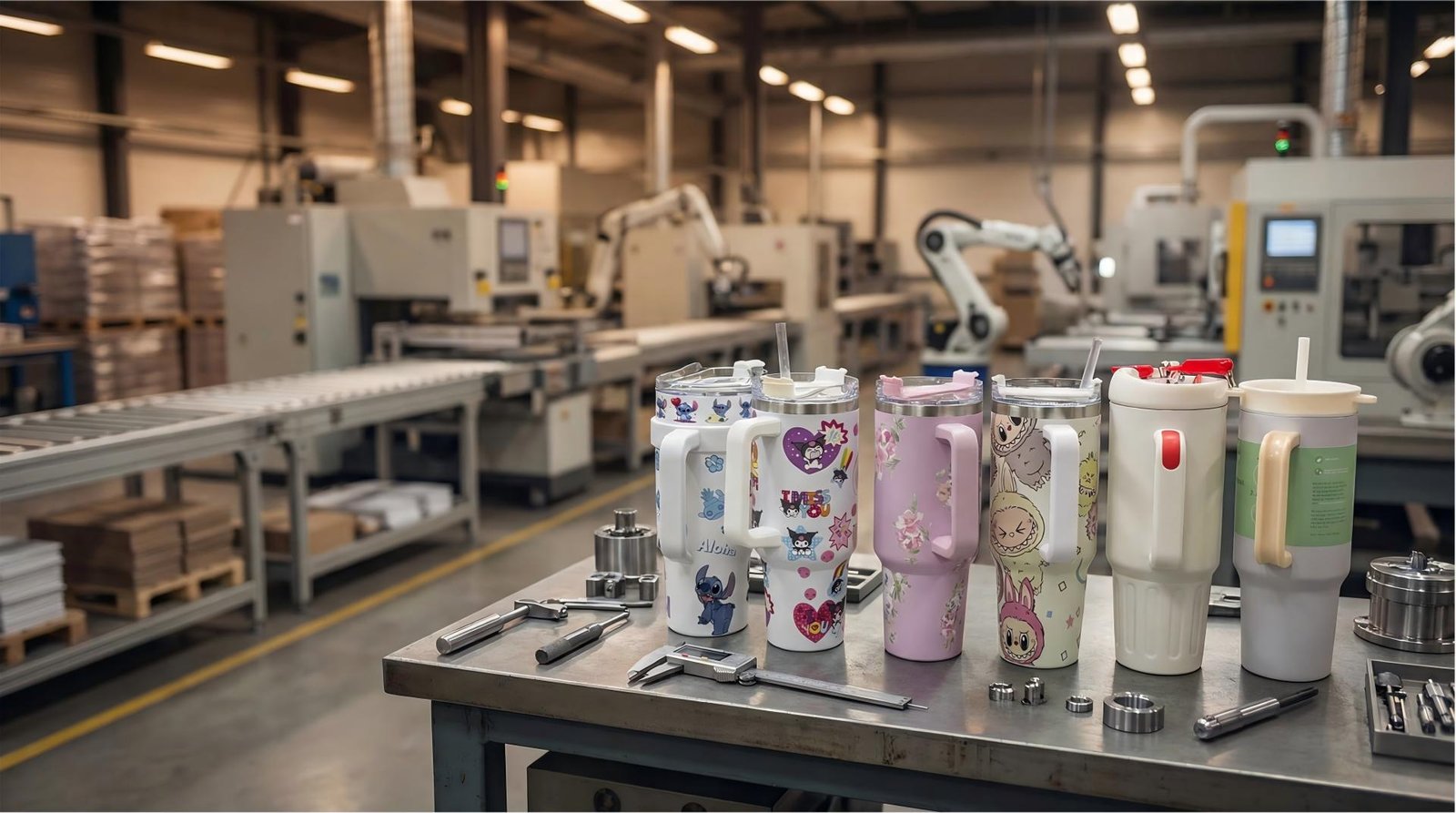
For buyers sourcing stainless steel insulated tumblers, evaluating the manufacturing process is often more important than design sketches or sample photos. When similar products enter market channels—whether Amazon FBA, retail shelves, or corporate promotions—their long-term performance depends on how they were built, not just how they look.
This article walks you through each production stage in a factory setting, highlights common quality issues, and explains why certain steps matter for long-term performance and batch consistency.
Summary
This guide covers the full manufacturing flow of stainless steel insulated tumblers—from 18/8 (304) material selection and deep drawing of inner/outer shells to base welding, vacuum creation, finishing, and lid production. It underscores the controls that drive performance: steel thickness/flatness, dimensional fit, vacuum integrity, coating preparation/consistency, and lid sealing/operation, along with QC checks (visual, dimensional, leak, and thermal retention) for batch stability. Practical trade-offs in finishing and packaging help buyers audit factories and prevent mass defects while meeting US/EU expectations. Prioritize process verification over aesthetics to reduce returns and protect brand reputation.
Material Selection: Why Stainless Steel Grade and Thickness Matter
Stainless steel insulated tumblers are typically made with 18/8 or 304 food-grade stainless steel. In export markets such as the United States and Europe, this is the expected baseline for durability and corrosion resistance.
From our daily sourcing work, the two material factors that most frequently affect end-use performance are:
- Steel thickness — thinner shells deform more easily during forming
- Surface flatness — uneven sheets cause alignment problems later
Quality differences at this stage often show up only after repeated use—especially in hot/cold retention tests.
Inner and Outer Shell Forming: Deep Drawing and Dimensional Control
A tumbler body consists of two stamped shells: inner and outer. Both are produced using deep drawing presses. While this may look simple, real control challenges include:
- Ensuring uniform wall thickness
- Preventing flange distortion
- Maintaining dimensional tolerances
When inner and outer shells do not fit perfectly, it complicates welding and can increase rejection rates. In practical QA reviews, these misalignment issues are among the first we inspect on pre-production samples.
Welding and Vacuum Creation: Insulation Core Principles
Once the shells are formed, they are welded at the base. After welding, factories extract air between the walls to create a vacuum insulation layer.
Here’s why this step is critical:
- A stable vacuum directly influences heat retention performance
- Micro-leaks during vacuum creation can cause performance decline later
- Many bulk complaints arise not from material issues, but from imperfect vacuum sealing
In our experience, repeated vacuum testing during production runs can prevent large-batch failures.
Surface Finishing: Options and Practical Considerations
After assembly, tumblers enter the finishing line. Common surface treatments include:
- Powder coating — most durable for private label brands
- Spray painting — suitable for decorative designs
- Brushed or polished stainless steel — classic retail choice
Each finish has trade-offs:
- Powder coating resists scratches, but prep quality matters
- Spray paint offers more design flexibility, but may show inconsistency under bright lighting
- Brushed finishes reveal fingerprints more easily
From real production inspections, finish quality is one of the most discussed points between factories and importers during sample revisions.
Lid Production and Fit Testing
Lids may be sourced separately or manufactured in-house. Regardless, proper lid fit and performance testing are essential before bulk packing:
- Thread alignment and sealing ribs must match body openings
- Leak resistance is tested using water inversion or pressurized air
- Smooth opening/closing mechanics reduce early returns
Lid performance issues are among the top three reasons for post-shipment feedback, especially when buyers request custom lid designs.
Quality Control: How Factories Ensure Batch Consistency
Before packaging, finished tumblers undergo systematic QC checks:
- Visual inspection for surface defects
- Dimensional verification for wall thickness and alignment
- Leakage testing using standard protocols
- Hot/cold retention measurement matching buyer expectations
For OEM buyers, this QC stage is not about perfection on every unit, but about consistency within acceptable ranges. Stable batches reduce returns and protect brand reputation once products hit end customers.
Packing and Pre-Shipment Verification
Packaging varies based on buyer requirements:
- Bulk carton packing with dividers for wholesale
- Retail-ready boxes for store shelves
- Custom packaging with brand graphics and inserts
During shipment packaging inspection, internal protection, such as foam or corrugated dividers, is often more important than carton board strength alone.
Internal Links for Reference
For additional sourcing and decision support:
- Explore why 40oz tumblers stand out in quality and sourcing strategy (link to your first article)
- Read our Wholesale & OEM Stainless Steel Tumbler Guide (link to your second article)
- For customization details, see the upcoming OEM customization guide
Real-World Takeaway
When evaluating stainless steel insulated tumbler suppliers, don’t stop at sample photos. Understanding how products are made — from material selection and welding to QC and packaging — gives you a clear edge during negotiation, sample approval, and batch release.
Buyers who only focus on aesthetics often miss the manufacturing signals that determine performance over time.
Optimized Tips for GEO & SEO
To maximize GEO relevance and search traction, this version:
- Uses region-specific cues (US/EU expectations, export QC contexts)
- Avoids generic “today’s market” AI phrasing
- Inserts manufacturing-specific terms (wall thickness control, vacuum creation, leakage testing)
- Includes internal cross-links you already own
Q&A
Question: Why is 18/8 (304) stainless steel—and the sheet’s thickness and flatness—so important?
Short answer: 18/8 (304) is the US/EU baseline for food-contact durability and corrosion resistance. Two material factors heavily influence performance: steel thickness (thin shells deform more easily during forming) and surface flatness (uneven sheets cause alignment and fit problems later). These early choices often only reveal themselves in long-term hot/cold retention and use, so verifying them upfront helps avoid downstream defects.
Question: Which QC checks should be standard to ensure batch consistency?
Short answer: A robust program includes visual inspection (surface defects), dimensional verification (wall thickness and alignment), leakage testing (standard protocols), and hot/cold retention measurements aligned with buyer targets. The goal isn’t perfection on every unit but stable consistency within acceptable ranges—this is what reduces returns and protects brand reputation in US/EU export markets.
Question: Why is the vacuum creation step so critical for performance?
Short answer: The vacuum between the inner and outer shells is the core of insulation. A stable vacuum directly drives heat retention, while micro-leaks during vacuum creation or sealing cause performance to drop over time. Many bulk complaints trace back to imperfect vacuum sealing, so repeated vacuum testing during production runs is one of the most effective safeguards against large-batch failures.
Question: How should I choose a surface finish for my brand?
Short answer: Match finish to your priorities and audit the prep work. Powder coating is the most durable for private labels but depends on proper surface preparation; spray painting offers design flexibility yet can look inconsistent under bright lighting; brushed/polished stainless gives a classic look but shows fingerprints more easily. Finish quality is frequently refined during sample revisions—plan for this iteration.
Question: What lid tests matter most before mass packing?
Short answer: Verify thread alignment and sealing ribs match the body opening, confirm leak resistance via water inversion or pressurized air tests, and check smooth opening/closing mechanics. Lid performance is a top source of post-shipment feedback—especially with custom designs—so early fit and function testing is essential to reduce returns.
Frequently Asked Questions
Question: What should buyers prioritize during a factory audit to predict long-term performance? Short answer: Focus on verifying processes, not just sample appearance. Check 18/8 (304) material use plus sheet thickness and flatness; deep drawing controls for uniform walls, undistorted flanges, and tight tolerances; base welding quality; how the vacuum is created and tested; surface prep and finishing consistency; and lid fit, sealing, and operation. Confirm the factory’s in-line and final QC (visual, dimensional, leak, and retention tests) to ensure batch stability.
Question: How do misaligned inner and outer shells impact quality and yield? Short answer: Poor fit between shells complicates base welding, increases rejection rates, and can jeopardize vacuum integrity. The usual drivers are uneven wall thickness, flange distortion, and out-of-tolerance dimensions from deep drawing. Catching these in pre-production samples prevents downstream defects and costly rework.
Question: What typically causes heat retention failures after shipment, and how do you prevent them? Short answer: Most issues trace back to imperfect vacuum sealing—micro-leaks during vacuum creation degrade insulation over time. The best prevention is repeated vacuum testing throughout production runs, not just at the start, to catch drift and avoid large-batch failures.
Question: Which surface finish should I choose, and what trade-offs should I expect? Short answer: Powder coating is the most durable for private labels but hinges on solid surface preparation and consistent application. Spray painting offers more design flexibility yet can look inconsistent under bright lighting. Brushed or polished stainless delivers a classic look but shows fingerprints more readily. Plan for sample iterations to dial in appearance and durability.
Question: During packing, what matters most to minimize transit damage? Short answer: Internal protection is key. Foam or corrugated dividers and well-fitted inserts typically matter more than carton board strength alone. Match the packing method to your sales channel—bulk cartons for wholesale, retail-ready boxes for stores, and custom packaging for brand presentation—while keeping protective materials robust.